
Suspected ectopic pregnancy requires the right level of care quickly: a stable patient needs prompt specialist assessment, while collapse, fainting, heavy bleeding or signs of shock require an emergency department immediately. By the end, you will know which hospital capabilities to verify, how doctors confirm the diagnosis, how treatment options differ and what to ask before choosing care in Mumbai.
Key takeaways
- Call 112 for fainting, collapse, severe pain, heavy bleeding or signs of shock.
- Hospitals use transvaginal ultrasound and serial beta-hCG blood tests to investigate ectopic pregnancy.
- Treatment depends on stability, scan findings, beta-hCG levels and future fertility plans.
- Ask surgeons about laparoscopy, salpingectomy, salpingostomy and emergency backup arrangements.
When suspected ectopic pregnancy requires an ambulance or emergency department
Fainting, collapse, dizziness, severe or increasing abdominal pain, worsening shoulder-tip pain, heavy vaginal bleeding, a fast heartbeat, or pale, clammy skin can signal a ruptured ectopic pregnancy and internal bleeding. Call 112 in India or go directly to an emergency department; do not wait for an appointment with an ectopic pregnancy doctor in Tardeo.
- Choose a hospital with emergency gynaecology, an on-call gynaecologist, anaesthesia, an operating theatre, blood-bank access and postoperative monitoring.
- Do not use a consultation-only clinic or standalone scan centre when the patient is unstable. They cannot control haemorrhage or provide emergency surgery, and transfer after collapse adds dangerous delay.
- If the patient is stable but has pain, bleeding or a positive pregnancy test, arrange urgent specialist assessment at a hospital rather than a routine appointment. Ask whether quantitative serum beta-hCG testing and transvaginal ultrasound are available promptly.
- If safe, bring pregnancy records, medication details, blood-group information and previous scan reports. Do not delay departure to collect them.
A patient can deteriorate from tubal rupture even after appearing well. If rupture is possible, the correct destination is a hospital equipped to assess, resuscitate and operate immediately—not simply the nearest ectopic pregnancy specialist or scan appointment.
How Tardeo hospitals confirm an ectopic pregnancy
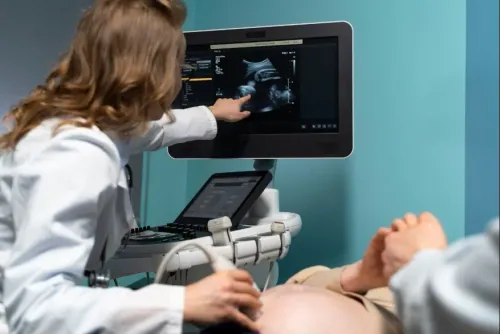
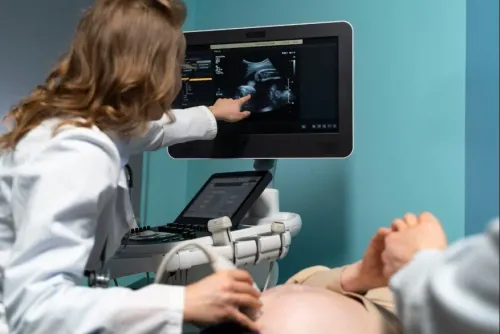
A positive urine pregnancy test confirms pregnancy, not where it is growing. At hospital, clinicians usually order a quantitative serum β-hCG test, which reports the hormone level as a number, and arrange a transvaginal ultrasound to look for a pregnancy inside the uterus or in a fallopian tube.
One β-hCG result cannot prove pregnancy location or viability. If the scan shows neither an intrauterine pregnancy nor an ectopic pregnancy, the pregnancy may simply be too early to locate; the alternatives include an early viable pregnancy, miscarriage or ectopic pregnancy.
The team usually repeats quantitative β-hCG after about 48 hours and compares the trend with the ultrasound findings.
Doctors combine that evidence with abdominal or pelvic pain, vaginal bleeding, examination findings and vital signs such as blood pressure and pulse. A falling or rising hormone level does not override worsening symptoms or signs of internal bleeding.
Before non-emergency assessment, ask:
- Is quantitative serum β-hCG testing available promptly?
- Is transvaginal ultrasound available on site?
- Can a gynaecologist review the results urgently?
- Does the hospital provide anaesthesia, an operating theatre, blood products and postoperative monitoring?
- Is there a documented transfer pathway if pain, bleeding, fainting or unstable vital signs develop?
A scan-only or consultation-only centre is not an adequate destination if rupture is suspected.
Which treatment is appropriate: monitoring, methotrexate or surgery?
Expectant monitoring suits only a stable patient with mild or absent pain, an ectopic pregnancy likely to resolve, a falling or low beta-hCG trend and reliable follow-up. Methotrexate needs scheduled blood tests and is unsuitable for suspected rupture, haemodynamic instability, important liver or kidney disease, or inability to return for review.
Symptoms, ultrasound findings and beta-hCG concentration also determine suitability.
OptionWhat it meansWhen it appliesExpectant monitoringObserve symptoms and beta-hCG without immediate treatmentStable patient with supportive findings and reliable follow-upMethotrexateInjection that stops ectopic pregnancy cells growingSelected stable patients without contraindicationsLaparoscopic surgeryKeyhole removal or treatment of the ectopic pregnancyStable patient needing surgery when expertise and equipment are availableOpen surgery by laparotomyAbdominal operation for rapid access to bleedingShock, major internal bleeding or need for fastest haemorrhage control
NICE recommends surgery as first-line treatment for significant pain, an unruptured ectopic mass at least 35 mm, visible fetal cardiac activity outside the uterus, serum beta-hCG at least 5,000 IU/L, or inability to complete follow-up.
Laparoscopic ectopic pregnancy surgery in Mumbai is usually preferred for a stable patient, but the hospital must provide emergency gynaecology, anaesthesia, an operating theatre, blood-bank support and postoperative monitoring.
Doctors also weigh rupture status, ectopic size, the condition of the opposite tube and your fertility plans. A scan-only or consultation-only clinic is not adequate when internal bleeding is possible.
What laparoscopic surgery involves and how the tube choice affects fertility
Laparoscopic surgery uses general anaesthesia and small abdominal incisions, usually one for a camera and others for instruments. Beforehand, the team reviews your symptoms, vital signs, ultrasound, quantitative beta-hCG, blood count, blood group and the condition of the opposite tube; consent covers bleeding, transfusion, conversion to open surgery and the planned tube procedure.
The surgeon inspects the pelvis, identifies the ectopic pregnancy, controls internal bleeding and chooses removal or repair based on safety and future fertility.
OptionWhat the surgeon doesWhy it may be chosenSalpingectomyRemoves the affected fallopian tubeUsually offered when the opposite tube is healthySalpingotomyOpens the affected tube, removes the pregnancy and leaves the tube in placeConsidered when the opposite tube is absent or damaged and preserving tubal tissue could matter
Salpingotomy has a specific cost: ectopic tissue can remain inside the tube. NICE guidance requires quantitative serum beta-hCG testing every week until the result is negative; further methotrexate or surgery may be needed if levels do not fall adequately. Removing one tube does not automatically prevent future pregnancy when the other tube functions normally.
Laparoscopic ectopic pregnancy surgery in Mumbai is generally used for a haemodynamically stable patient when the team has the necessary equipment. Laparoscopy is unsuitable with haemodynamic instability, suspected major bleeding, extensive adhesions or a pregnancy requiring another surgical approach; laparotomy then provides faster access to control haemorrhage.
How to choose an ectopic pregnancy surgical provider in Mumbai
An ectopic pregnancy specialist in Andheri West and a provider elsewhere in Mumbai should pass the same safety checks. Confirm the gynaecologist’s registration and specialty credentials in the National Medical Commission register, then identify the hospital where surgery actually takes place. A consultation address does not prove 24-hour surgical capability.
CheckConfirmWhy it mattersEmergency cover24-hour access and an on-call obstetrician-gynaecologistStable patients can deteriorate after tubal ruptureDiagnostic capacityTransvaginal ultrasound and quantitative serum beta-hCG testingResults guide urgent treatment decisionsSurgical supportAnaesthesia, an operating theatre, blood products and postoperative monitoringThese are essential for ectopic pregnancy surgery in MumbaiTransfer planThe documented pathway if rupture or major bleeding occursTransfer after collapse is riskier than presenting at a capable hospital
Dr. SPENTA's GYNAEC CLINIC may provide specialist assessment for a stable patient, but ask which hospital, surgical team and emergency arrangements would apply before booking.
After surgery, ask whether you need anti-D immunoglobulin if you are Rh-negative; NICE recommends it for surgical management, not solely medical or expectant treatment. After salpingotomy, arrange weekly quantitative beta-hCG tests until negative because persistent ectopic tissue can remain and require methotrexate or further surgery.
In a subsequent pregnancy, contact a clinician early for an ultrasound confirming an intrauterine location.
Related service
LAPAROSCOPY
This is a condition when a fertilised egg implants outside of your uterus most commonly in your Fallopian Tube.
Frequently asked questions
- When does suspected ectopic pregnancy require an ambulance or emergency department?
- Call 112 or go directly to an emergency department for fainting, collapse, dizziness, severe or increasing abdominal pain, worsening shoulder-tip pain, heavy vaginal bleeding, a fast heartbeat, or pale, clammy skin.
- How do Mumbai hospitals confirm an ectopic pregnancy?
- Doctors assess symptoms, perform a transvaginal ultrasound and measure beta-hCG in blood. Repeat beta-hCG testing and ultrasound can clarify cases that remain uncertain.
- How do doctors choose between monitoring, methotrexate and surgery?
- The choice depends on your circulation and symptoms, ultrasound findings, beta-hCG level, absence or presence of a heartbeat outside the uterus, medical suitability and fertility plans.
- What happens during laparoscopic ectopic pregnancy surgery?
- Under general anaesthesia, surgeons use small abdominal incisions and a camera to treat the pregnancy. They may remove the affected tube with a salpingectomy or open it to remove the pregnancy with a salpingostomy.
- How should you choose an ectopic pregnancy surgical provider in Mumbai?
- Check the provider's emergency access, gynaecological laparoscopic experience, anaesthesia and blood-bank arrangements, diagnostic capability, follow-up plan and explanation of fertility implications.
Keywords