
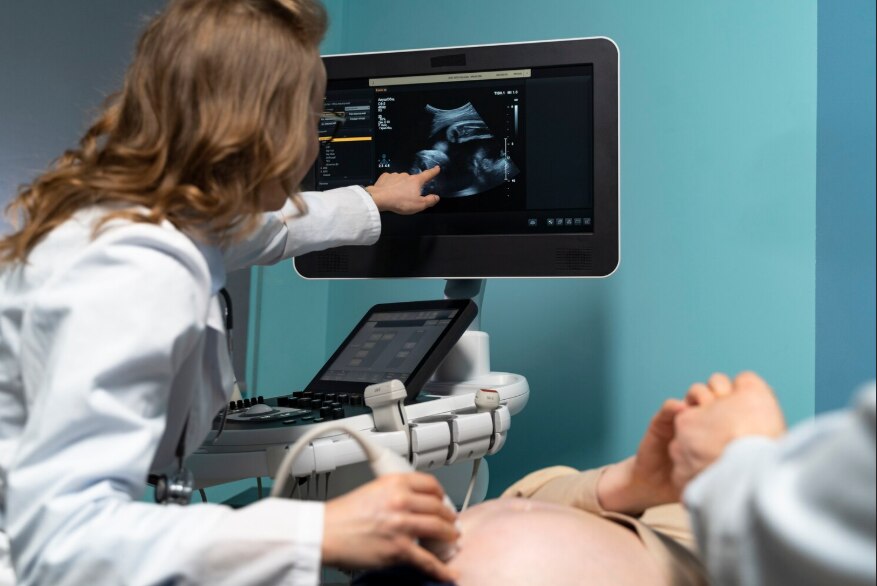
An obstetric ultrasound appointment involves more than lying on an examination bed: the centre first verifies your pregnancy details, gives preparation instructions and identifies the correct scan for your gestational age. By the end, you should know what to bring, who performs each step, how abdominal and transvaginal examinations differ, and what to do with the written report.
Key takeaways
- Confirm the scan type, gestational age and preparation instructions before booking.
- Ask for the facility’s PCPNDT Act registration details and reporting doctor’s name.
- Bring your referral, prior reports and requested test details to registration.
- Use the report for follow-up decisions, not as a substitute for clinical assessment.
Before you leave home: referral, booking and preparation
Book the appointment for the requested scan and gestational age, not simply for a “pregnancy ultrasound in Mumbai.” Ask the centre whether it is registered under the PCPNDT Act, who will perform and report the examination, what preparation is required, and how urgent findings are communicated.
An obstetrician may request the scan without operating the machine.
- Ask your doctor for the prescription or referral stating the indication, such as viability, dating, nuchal translucency, anomaly or growth assessment.
- Confirm the appointment time and bring the prescription, previous ultrasound reports, blood-test results, estimated due date and relevant medical history, including prior pregnancies, surgery, bleeding or pain.
- Follow the centre’s bladder instructions. An early abdominal scan may need a partly full bladder, while a transvaginal scan is usually done after you empty it. Do not drink a fixed amount unless the facility tells you to.
- Ask whether a transvaginal examination is planned for an early pregnancy. The closer vaginal probe can produce clearer early images; when clinically indicated, the scan is considered safe and does not cause miscarriage.
- Carry identification and arrive early enough for registration and consent. Pregnancy imaging requires prescribed records and consent under India’s PCPNDT framework; fetal sex determination or communication is prohibited.
These checks make the obstetric ultrasound scan process in mumbai smoother and help the operator compare today’s findings with earlier records. Keep your phone available after the appointment if the reporting doctor needs to discuss an urgent result.
Registration, consent and the scan itself
At reception, staff verify your identity and pregnancy details, review the referral and confirm the gestational age. They check earlier reports if available and record the reason for the examination. Before imaging, the centre explains the procedure, obtains the required written consent and should be registered under India’s PCPNDT framework.
Sex selection and communication of fetal sex are prohibited.
The visit usually follows this sequence:
- You change or expose only the area needed and lie on your back on the examination bed, with support under your knees if required.
- For an abdominal scan, the operator applies ultrasound gel to your lower abdomen and moves the probe across the skin. Follow the centre’s bladder instructions; an early abdominal scan may need a partly full bladder.
- For an early transvaginal scan, you empty your bladder, undress from the waist down and cover yourself. The covered, lubricated probe is inserted gently into the vagina; it gives clearer images when the uterus and embryo are still small and does not cause miscarriage.
- The operator records images, measurements and observations, then prepares or sends them for the written report.
A sonologist or radiologist normally performs and reports the examination. Your obstetrician may request the scan, explain why it is needed and interpret the report with your symptoms, but an obstetrician is not automatically the person operating the machine.
When booking a pregnancy ultrasound in Mumbai, ask who will scan and who will sign the report; an “obstetrician ultrasound scan in Mumbai” search does not answer that question.
How the examination changes during pregnancy
A viability scan checks whether the pregnancy is in the uterus, how many embryos are present and whether cardiac activity is visible. The examination then changes as the fetus develops.
| Scan | Usual timing | What it examines |
|---|---|---|
| Viability | Early pregnancy | Pregnancy location, embryo number, cardiac activity and early development |
| Dating | First trimester | Crown–rump length and estimated gestational age, especially when the last menstrual period is uncertain |
| Nuchal-translucency | 11 weeks to 13 weeks 6 days | Nuchal translucency, nasal bone and other markers used with maternal age and blood tests to assess chromosomal-risk screening |
| Anomaly | About 18 to 22 weeks | Brain, face, spine, heart, abdomen, limbs, kidneys, placenta and amniotic fluid for structural abnormalities |
| Growth | Usually later pregnancy, as advised | Head, abdomen and femur measurements, estimated fetal weight, growth trend, presentation, placenta and fluid volume |
| Doppler | When a clinical question requires it | Blood-flow patterns in vessels such as the umbilical artery or middle cerebral artery, including suspected growth restriction or placental insufficiency |
The same milestones guide a prenatal ultrasound in Mumbai, but timing can shift for bleeding, pain, uncertain dates, multiple pregnancy or medical conditions. A very early viability scan can be inconclusive; your clinician may recommend a repeat scan or serial blood tests.
Growth scans do not weigh the fetus directly. The estimated weight has measurement error, so clinicians compare it with earlier scans, fluid, Doppler findings and your medical history rather than treating one figure as exact. This is a key part of the obstetric ultrasound scan process in Mumbai.
The report, follow-up and limits of ultrasound findings
The report records what was examined, the measurements obtained and any finding that changes care. For a pregnancy ultrasound in Mumbai, check that it identifies the gestational age, scan indication and person who performed and reported the examination.
It commonly includes:
- Pregnancy location, number of fetuses, cardiac activity and gestational age
- Crown–rump length in an early scan; biparietal diameter, head circumference, abdominal circumference and femur length later
- Estimated fetal weight, which is calculated rather than directly measured
- Placental position, amniotic-fluid volume, cervical length and fetal presentation
- Anatomy reviewed, including the brain, spine, heart, abdomen, kidneys and limbs
- Doppler measurements of blood flow when growth restriction or another concern requires them
A single measurement does not tell the whole story. Estimated fetal weight has a meaningful error margin, especially late in pregnancy, so your clinician compares it with earlier growth, fluid volume, Doppler results and your medical history.
You may need another scan when:
- An early scan cannot confirm viability or the dates are uncertain; repeat ultrasound or serial beta-hCG blood tests may follow
- Views are incomplete because of fetal position, body habitus or limited image quality
- Growth, fluid, placenta, cervix or Doppler findings need monitoring
- A suspected abnormality requires a targeted scan, fetal echocardiogram, genetic counselling or diagnostic testing
A prenatal ultrasound in Mumbai can identify structural concerns, but it cannot detect every condition or guarantee a healthy baby. Ask how and when an urgent result will be communicated rather than waiting for a routine appointment.
How to choose a pregnancy ultrasound facility in Mumbai
Distance matters less than whether the facility fits your clinical question. For an obstetrician ultrasound scan in Mumbai, check the centre’s registration, the professional performing and reporting the examination, and whether the appointment matches your gestational age and indication.
A pregnancy scan near me is not automatically suitable for a nuchal-translucency, anomaly, growth or Doppler scan.
| Facility check | What to verify | Why it matters |
|---|---|---|
| PCPNDT registration | The centre is registered under the PCPNDT Act and obtains the required consent and records | Pregnancy imaging must follow India’s rules; fetal sex determination or communication is prohibited |
| Operator and report | Ask whether a sonologist or radiologist will perform and report the scan; do not assume the obstetrician operates the machine | “Obstetrician” describes a medical role, not necessarily the ultrasound operator |
| Scan scope | Confirm the named scan, gestational-age range, measurements and written findings included | A basic scan may not provide the assessment required for anomaly, growth or Doppler evaluation |
| Urgent communication | Ask who explains an urgent finding and how quickly your referring doctor receives the report | A report without a follow-up route can delay treatment |
Before booking, ask whether an early scan requires a transvaginal approach; it can show early structures more clearly and does not cause miscarriage when clinically indicated. Avoid choosing solely for 3-D or 4-D images, since diagnostic quality and qualified interpretation matter more.
If you book through Dr. SPENTA's GYNAEC CLINIC, use these questions to confirm which professional performs the scan and how the report returns to your treating doctor.
Related services
OBSTETRICS An ultrasound is a procedure that uses sound waves to create images of your baby while it’s in the uterus. View service → |
OBSTETRICS can identify whether your baby is more or less likely to have any birth defects or genetic disorders like Down syndrome, Chromosonal abnormalities,... View service → |
Frequently asked questions
What should you do before an obstetric ultrasound scan in Mumbai?
Book the scan for the requested examination and gestational age, confirm preparation instructions, and bring your referral and previous reports.
What happens during a pregnancy ultrasound in Mumbai?
After registration and consent, the sonographer performs the examination using the method required for your stage of pregnancy and provides findings for reporting.
How does an ultrasound examination change during pregnancy?
The scan’s purpose, measurements and examination method change with gestational age, so book the specific scan requested by your obstetrician.
What are the limits of an obstetric ultrasound report?
An ultrasound report records the findings visible during that examination; your obstetrician must interpret them with symptoms, history and other tests.
How can you choose a pregnancy ultrasound facility in Mumbai?
Check PCPNDT Act registration, ask who will perform and report the scan, confirm preparation requirements, and ask how urgent findings are communicated.
Keywords