Thank you for writing to us. One of our executive will reach back to you through your submitted medium. In case there’s an urgency, feel free to connect over WhatsApp for faster response.
Prefer calling? Dial +919321549004 (International callers) or +919321549004 (Indian callers).
What are fibroids ? Fibroids are the commonest ben...
6633291d95821c1e2ceac7f8"
What are fibroids ?
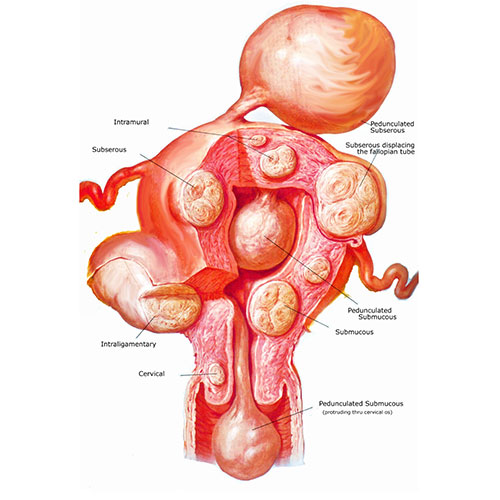
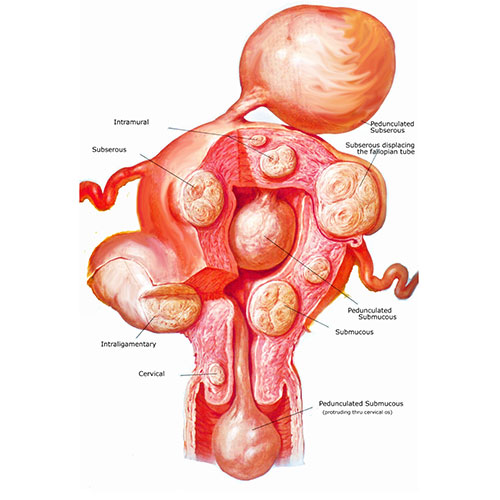
Fibroids are the commonest benign tumours of the uterus.
It is extremely prevalent & most common from ages of 20-45 yrs.
It may be present in as many as 25-50% of women population.
Fibroids essentially are non cancerous masses but may undergo changes & degenerations which make some more dangerous than others
Not all fibroids need removal. Only 40% of women with fibroids need treatment.
Warning Signs & Symptoms that you may have fibroids
Nearly 40-50% will have no symptoms to realise that they may be having fibroids & often detected on incidental Sonography
Heavy bleeding with passage of clots which may cause Anemia – drop in Haemoglobin.
Dysmenorrhoea – Painful Periods
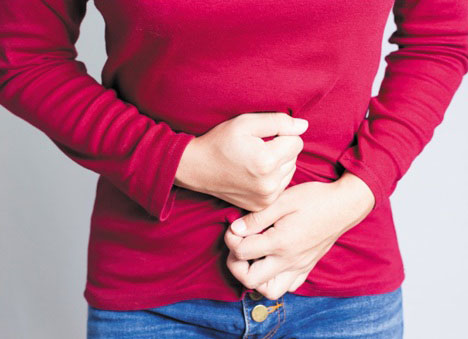
Heaviness in abdomen & bloating
Pressure effect of fibroids – Urinary frequency & Constipation
Difficulty in conceiving – Sub- Fertility
Recurrent Miscarriages
How are fibroids detected & what investigations you may need ?
Sonography with Color Doppler – identifies nature & location of fibroids. Doppler assesses blood flow patterns giving clarity about the nature of fibroids.
MRI occasionally in cases of multiple fibroids for accurate mapping & in suspected dangerous fibroids
Blood tests depend on the treatment plan
Basic Haemogram CBC, Prolactin & Serum LDH isoenzyme 3 which gives a clue if the fibroids have degenerations or bad changes.
What are your treatment options ?
Medicines work on fibroids but the effect is temporary and only reserved usually to tide over crisis.
Tablets or injections reduce blood flow through fibroids, reduce symptoms like pain & bleeding and may cause slight reduction in size.
Essentially if symptoms are severe your fibroids will need Surgical Removal.
Removal of uterus unless age is above 45 years and child-bearing & family is completed is NOT the treatment of fibroids.
Bhatia hospital, Tardeo road, Grant Road West, Mumbai, India
400007
Mumbai
India
+919321549004
Dr. SPENTA's GYNAEC CLINIC
https://www.drspentasumondy.in
1
True
False
False
Sujay Hospital
Dr Spenta Sumondy Dave's Gynaec Clinic
Wockhardt Hospitals, Mumbai Central
Conwest and Manjula S Badani Jain Hospital
Masina Hospital
Bhatia Hospital
Infertility Investigation
Sterilisation and Tubal Ligation
Ectopic Pregnancy
Hysterectomy
Ovarian Cyst
Obstetric Ultrasound Scan
Screening Tests
Complex Obstetric Surgery
Antenatal care
Normal Labour Delivery
High Risk Pregnancy
Uterine Fibroids
Contraception
Pap Smear
Prolapse of Uterus
Infertility Management
Menopause